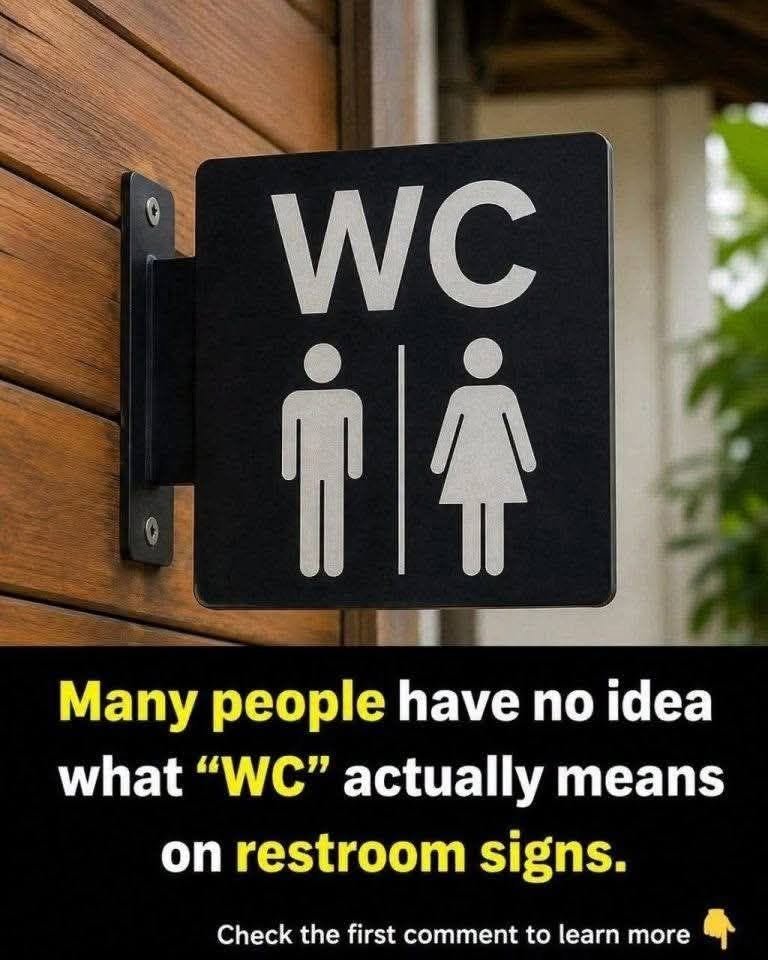
If you have ever traveled internationally, you may have noticed the letters “WC” appearing on restroom signs, hotel directories, train stations, or public buildings. For many people in the United States and Canada, the abbreviation can seem unusual because “WC” is not commonly used in everyday North American English.
So, what does it actually mean?
También te puede interesar


The answer is surprisingly simple: WC stands for “water closet.” The term is an older expression for a room containing a toilet.
Where Did the Term “Water Closet” Come From?
The phrase “water closet” dates back centuries and became particularly associated with the development of indoor plumbing.
Historically, a “closet” could refer to a small private room rather than a storage space. When toilets began incorporating water-based flushing systems, the term “water closet” became a practical way to distinguish these facilities from older forms of toilets.
As indoor plumbing became increasingly common, the abbreviation WC was adopted in signs, architectural plans, directories, and other forms of labeling.
Over time, the full phrase became less common in everyday conversation, but the abbreviation remained widely recognizable in many parts of the world.
Why Is “WC” More Common Outside North America?
Language and cultural habits have a major influence on how restrooms are labeled.
In the United States and Canada, people generally use words such as “restroom,” “bathroom,” or “washroom.” In other English-speaking regions, “toilet” is often the standard everyday term.
Across continental Europe and other parts of the world, however, WC remains a familiar international abbreviation. Travelers may encounter it in airports, restaurants, hotels, shopping centers, train stations, and other public locations.
This makes “WC” particularly useful in places where signs need to be understood by visitors who speak different languages.
Does WC Mean the Same Thing as a Bathroom?
Not always.
Traditionally, a water closet refers specifically to the room or enclosed space containing a toilet. A modern bathroom, by contrast, may include several fixtures, such as a bathtub, shower, sink, and toilet.
The distinction can still matter in architecture and real estate terminology.
In some North American homes, for example, a small enclosed room containing only a toilet and sometimes a sink may be described as a water closet. The term can also appear in building plans when architects want to identify a specific toilet area.
In everyday conversation, however, most people simply use “bathroom,” “restroom,” or another familiar local term.
Why Do Hotels and Airports Use WC?
International facilities often need signs that can be understood quickly.
An abbreviation such as WC takes up very little space and can be recognized by travelers from different countries. This is especially useful in busy locations such as airports and railway stations, where people may be looking for facilities while navigating an unfamiliar building.
Restroom signage also frequently combines text with universal symbols. These visual icons can make it easier for travelers to find the appropriate facility even when they do not speak the local language.
Is “WC” Still Technically Correct?
Yes. Although “water closet” sounds old-fashioned to many English speakers in North America, WC remains a legitimate and widely understood abbreviation.
The term has also survived in technical, architectural, and plumbing contexts. Building plans may use “WC” to identify a toilet, while plumbing terminology can distinguish a water closet from other bathroom fixtures.
That is why someone who has never heard the phrase in casual conversation may still encounter it regularly while traveling.
Other Restroom Terms You May Encounter
Travelers may see several different words depending on the country.
In the United States, “restroom” is common in public places, while “bathroom” is widely used in everyday conversation. In Canada, “washroom” is also very common.
In the United Kingdom and many other countries, “toilet” is generally more direct. Travelers may also encounter “lavatory,” particularly in formal or transportation-related settings.
Despite these differences, the purpose is the same: helping people identify where they can access toilet facilities.
A Small Detail With a Long History
The next time you see “WC” on a sign, you will know that the two letters have a much longer history than they might suggest.
What looks like a mysterious abbreviation is simply a shortened form of “water closet,” a term that emerged alongside the development of indoor sanitation and plumbing.
For modern travelers, WC has become a convenient international sign—short, recognizable, and useful even when the surrounding language is unfamiliar.
So, if you spot those letters while exploring another country, there is no mystery involved. You have simply found the restroom.