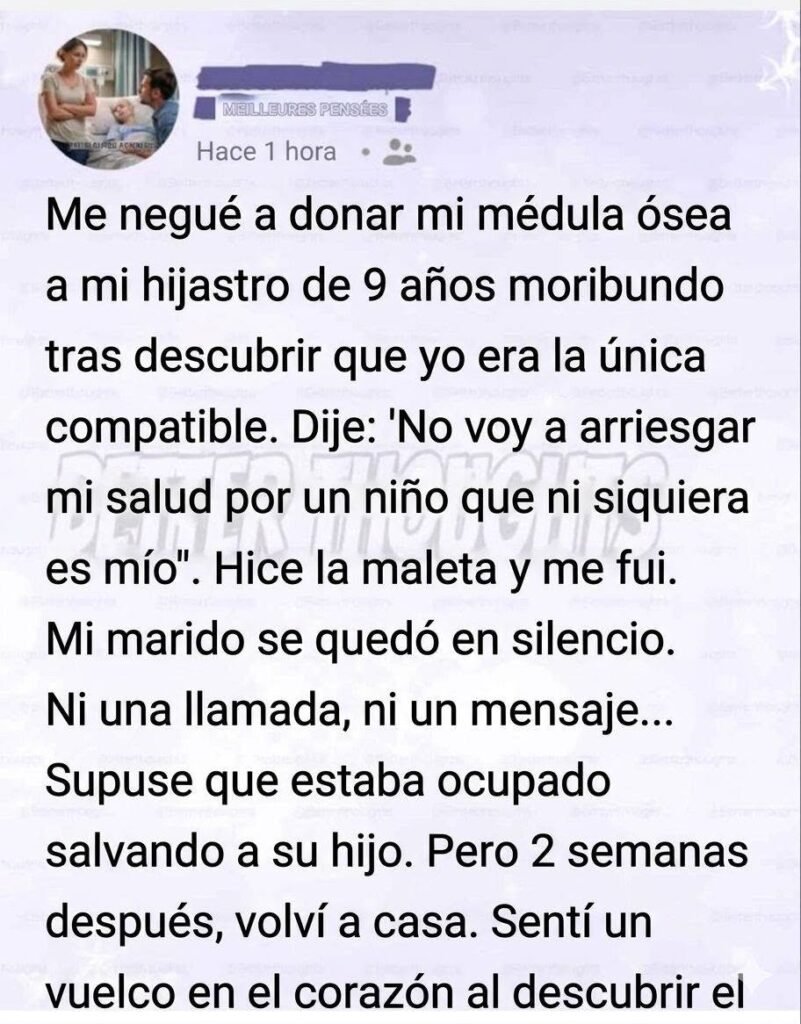
When doctors told me that I was the only compatible bone marrow donor for my nine-year-old stepson, I thought I had every right to say no.
También te puede interesar
I had been part of his life for only three years. I was not his biological mother, and I had never pretended otherwise. His father and I had married when the boy was six. By then, he already had his own routines, memories, and a relationship with his biological family.
So when the doctors explained that a transplant could save his life and that I appeared to be the only compatible donor available, I focused on one thing: the risks to me.
Bone marrow donation is a serious medical procedure. I worried about pain, complications, recovery time, and what could happen to my own health. I told myself that nobody should be pressured into undergoing a medical procedure simply because they were related to someone who needed help.
Then I said something that I would later regret.
“I’m not going to risk my health for a child who isn’t mine.”
The words sounded harsh even as I heard myself saying them.
A Family Divided by Fear
My husband was devastated.
He understood that the decision involved my body and that I had the right to ask questions. But he also struggled to understand how I could turn away when his son was facing a life-threatening illness.
Our conversations became increasingly difficult. He accused me of treating his son like a stranger, while I felt that he was ignoring the risks I was being asked to accept.
The boy knew that he was sick, but we tried to protect him from the details surrounding the donor search.
Still, children often understand more than adults realize.
One evening, I found him sitting quietly in the living room. He looked exhausted, but he smiled when he saw me.
“Are you scared?” he asked.
I told him I was.
He nodded and said something I will never forget.
“I’m scared too.”
For the first time, I stopped thinking about the situation only as a medical decision involving my body. I began seeing the frightened nine-year-old behind the diagnosis.
The Question That Changed My Perspective
Over the following days, I asked the medical team to explain everything again.
What were the actual risks? What would recovery involve? What alternatives existed? Was I truly the only compatible donor? What safeguards would be in place?
I realized that my first reaction had been based largely on fear and incomplete information.
The doctors did not tell me that donating was risk-free. They explained the procedure honestly, including potential complications and the expected recovery period. They also emphasized that any decision had to be voluntary and informed.
That distinction mattered.
I didn’t need to pretend there were no risks. I needed to understand those risks accurately.
More Than Biology
Eventually, I began thinking about what makes someone a parent or a family member.
Biology is important, but families are also built through everyday experiences: preparing meals, attending school events, helping with homework, listening after a difficult day, and being present when someone is afraid.
During those three years, I had gradually become part of this child’s life without fully realizing how important our relationship had become.
He called me when he needed help. He showed me drawings from school. He asked me questions that he didn’t always ask his father.
Perhaps I had been defining our relationship by what we were not rather than what we had already become.
The Decision
After several conversations with my husband, the medical team, and a counselor, I made my decision.
I agreed to become the donor.
It wasn’t because I suddenly believed there was no risk. It wasn’t because someone forced me. And it wasn’t because I thought being his stepmother meant I had an automatic obligation to undergo a medical procedure.
I made the decision because, after understanding the situation more clearly, I wanted to give him the chance to recover.
The procedure and recovery were difficult, but the experience changed the way I understood our family.
What I Learned
Not every family story has a perfect ending, and difficult medical decisions should never be reduced to simple questions of love or loyalty.
A person has the right to make decisions about their own body. At the same time, fear can sometimes make us view a situation more narrowly than we should.
My stepson did not become “mine” because I donated bone marrow. He was already someone I cared about.
What changed was my understanding of the relationship.
Sometimes, the moments that test a family also reveal what that family has quietly become. And sometimes, one difficult decision can force us to look beyond labels such as “biological parent” or “stepparent” and recognize the deeper bonds created through love, trust, and years of simply being there.